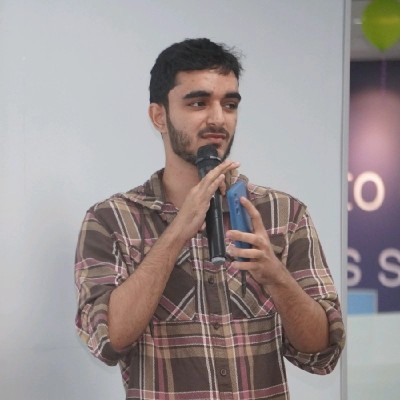
 👋🏻Fudail M Zafar
From a Metro Ride to Open Source
As a final-year Computer Science Engineering student, I spend a lot of time building systems—like this very portfolio app you're reading this on—and writing about the technical hurdles I cross. But if you were to ask me what has shaped me the most as a developer, the answer wouldn't be a university course or a specific tutorial. It would be Open Source.
My open source journey didn't start in a classroom or a hackathon. It started on a metro train. Yes, on a metro train! Lol.
The Metro Ride That Changed Everything
During the third semester of my second year, I was commuting on the metro when I struck up a conversation with a fellow passenger. He happened to be a software engineer at Larsen & Toubro. We hit it off, exchanged numbers before my stop arrived, and kept in touch over WhatsApp.
He quickly became a mentor to me. One day, he mentioned something I had never heard of: Hacktoberfest. It was October, and he was actively contributing. He gave me a simple piece of advice:
"Take this year for learning. Join next year and make your first contribution!"
I took his advice to heart. I spent the next year learning from YouTubers, dev communities, and technical blogs, preparing myself to dive in.
Nova Jam
By my third year, I was ready. I made my very first open source contribution to a community project called Nova Jam. We were building a product that generated QR code stickers for equipment; scanning the code would pull up maintenance reports and tracking details for that specific product.
I took on the frontend responsibilities. I worked on authentication screens, responsive design, and accessibility. It was my first taste of writing code that other people relied on, and I was hooked.
The T-Shirt
When October rolled around again, I was ready for Hacktoberfest. The stakes were clear: the first 10,000 people to land six Pull Requests (PRs) would win an exclusive T-shirt. For a developer just starting out, that was a highly rewarding goal.
I joined a Chicago-based open source community called Open Code Chicago. For the next month, I dedicated myself to their product—a fitness and gym web application. My focus was on frontend guidelines and accessibility. I built out legal pages, implemented strict WCAG accessibility standards (focus areas, ARIA labels), perfected the responsive design, and optimized performance and loading states.
The most amazing part wasn't just the code; it was the collaboration. I was working alongside developers from completely different time zones and countries. And yes—I made it into the first 10,000 people to merge six PRs and proudly earned my first open source T-shirt!
Doing bigger stuff now
As my confidence grew, I started participating in hackathons. Many of these events were sponsored by US-based startups that maintained their own open source tools.
This led me to my second major open-source milestone: Tambo AI, a React library for connecting AI to Generative UIs.
Jumping into a foreign startup's production codebase was intimidating. It took time to navigate their architecture and truly understand their tech stack. I started small—tweaking the user experience on their landing page and fixing responsive design bugs.
Once I proved myself, I was given a massive opportunity: revamping their entire authentication flow. Writing the code was one thing, but seeing my PR get approved and shipped into a live startup's product was an unbelievable feeling.
To top it all off, I participated in Tambo AI's sponsored hackathon, secured the runner-up position, and walked away with $600.
What Open Source Taught Me
When I started this journey, I had zero expectations of financial return or major accolades. I just wanted to learn.
Open source molded me into a vastly better developer than I was before. It is arguably the best way to learn how to break down complex systems, read other people's code, and understand scalable architecture.
Beyond the technical skills, it’s about the people. You get to meet and collaborate with brilliant minds from all over the planet. Knowing that lines of code you wrote in your bedroom are living inside someone else’s product on the other side of the world? That is a feeling you just can’t replicate.
If you are a student or a junior developer on the fence about open source—dive in. Find a project, read the contributing guidelines, and open your first PR. You never know where it might take you.
More from Fudail M Zafar
Hello World
3 min read